

Economic Development in Africa: Two important pieces of the puzzle
There is broad consensus on the need to accelerate Africa’s economic and social development. African governments recognize its urgency, and regional and international institutions support it.
So why does progress often remain slower than expected?
While Africa faces numerous development challenges, two stand out as fundamental: the volume and terms of development financing, and the quality of economic governance.
Development finance: Aligning financing with development needs.
Economic and social development require substantial investments in infrastructure and human capital. Yet the economic returns on these investments, particularly in education and health, often materialize only over the long term. In many cases, several decades, or even an entire generation, may pass before their full impact is reflected in higher productivity, incomes, and living standards.
However, much of the financing available to developing countries, whether domestic or external, remains characterized by maturities and grace periods that are significantly shorter than the economic and social payoff horizons of these investments.
Some regional and multilateral institutions, such as the concessional lending windows of the World Bank (International Development Association) and the African Development Bank (African Development Fund), do offer relatively favorable terms, with maturities of up to forty years and grace periods of around ten years. Yet the volume of concessional resources available remains far below the continent’s financing needs. Moreover, grace periods are often too short for investments in human capital whose economic benefits may take many years to materialize.
As concessional financing becomes scarce, many countries increasingly rely on international, regional, and domestic capital markets, as well as commercial financing, which typically carry higher costs, shorter and repayment periods. This trend increases financial vulnerability and may constrain countries’ ability to invest sustainably in their long-term development.
A better alignment between financing conditions and the payoff horizons of development investments is therefore essential. Such alignment would not only enable countries to invest more sustainably in their future but could also help reduce the risk of debt distress. For example, certain categories of investment may justify grace periods exceeding twenty years when their economic benefits are particularly delayed.
Nevertheless, even if development institutions were willing to extend maturities and grace periods further, the volume of resources available under such terms would likely remain insufficient to meet Africa’s enormous financing needs. Longer maturities increase lenders’ exposure to risk over extended periods and may limit their capacity to scale up such financing significantly.
Consequently, concessional finance alone cannot meet the continent’s development requirements. African countries must also mobilize other sources of long-term financing. This requires, among other measures including:
- Strengthening private investment through credible macroeconomic policies, an improved business environment, and well-designed, properly regulated public-private partnerships.
- Developing innovative financial instruments capable of attracting long-term private capital, including guarantee mechanisms, credit enhancement facilities, and diaspora bonds. The experience of several countries, notably Nigeria, demonstrates that diaspora bonds can be an effective tool for mobilizing the savings of citizens living abroad. Their success, however, depends on a critical prerequisite: investor confidence in the country’s institutions and the quality of its economic management.
Finally, it is important to recognize that no development financing strategy can sustainably rely on external resources alone. Domestic resource mobilization remains a fundamental pillar of sustainable development finance. In addition, more effective management of natural resources could substantially increase the fiscal space available to finance the investments required for long-term economic and social transformation.
Governance: Turning Resources into Results
Economic governance refers to a state's ability to use public resources efficiently, transparently, and responsibly in pursuit of economic and social development. It requires a strong sense of accountability on the part of public authorities toward citizens: creating conditions that enable people to meet their basic needs, develop their capabilities, and participate fully in economic life.
Good economic governance encompasses the fight against corruption, the reduction of waste in public spending, and sound public financial management. It also requires budgetary choices that prioritize high-impact investments, particularly in infrastructure, education, healthcare, and social protection.
Effective economic governance also strengthens investor confidence, encourages private investment, and improves the efficiency of public action. In doing so, it supports stronger and more inclusive growth while increasing resilience to economic shocks.
Yet for these gains to be sustainable, they must be underpinned by a robust framework of political governance based on the rule of law, institutional accountability, transparency in public decision-making, and citizen participation. Development is not built on financial resources alone; it also depends on trust in institutions.
Conclusion
Africa’s development challenge is not simply about mobilizing more resources. It is equally about ensuring that those resources are used effectively to generate lasting results.
The international community has a critical role to play by expanding the supply of concessional financing and by developing financing mechanisms whose maturities and terms are better aligned with the long-term requirements of economic and social development.
For their part, national authorities should continue reforms aimed at:
- strengthening public institutions, ensuring sound and transparent public resources management, and reinforcing the confidence of both citizens and investors;
- Improving public investment and debt management by ensuring that project selection, appraisal, and financing adequately reflect the alignment between financing conditions and the long-term economic and social returns of investment.
- Intensifying domestic resource mobilization through stronger tax administrations, accelerated digitalization of tax procedures, broader tax bases, and more efficient management of tax expenditures
Africa’s long-term prosperity will hinge not only on mobilizing greater resources but also on ensuring that those resources are translated into meaningful and lasting improvements in people's lives.
Public Administration in Africa: Moving from Knowing What to Do to Making It Happen
Across Africa, there is no shortage of reform plans. Reform agendas are well known, diagnoses are often clear, recommendations well documented, and successful regional and international examples exist. Yet implementation remains slow and uneven. Why?
Throughout my career in economic development on the continent, this question has consistently followed me. The same explanations are frequently cited: lack of capacity, budget constraints, weak political will, or complex socio-political environments. These factors are real, of course. But with hindsight, I am convinced that another factor—equally decisive and too often overlooked—is the management of human capital and organizational change within the public sector.
A telling reality: 400 employees, 40 contributors
One example struck me in particular. The head of a large public institution recently told me he had a staff of 400 people, yet estimated that barely 10 percent—around 40 individuals—were fully contributing to their roles. The others were physically present, but their impact on overall performance remained minimal.
Recently, another senior leader at an African institution told me he had been compelled to renew the contracts of several temporary staff members, even though their services were no longer needed.
Far from being isolated, such situations reflect a recurrent trend across numerous public administrations on the continent, prompting a central question: how to unlock the productivity of the existing workforce?
Three levers to unlock change
In my view, three essential ingredients are needed to move from theoretical reform to tangible transformation.
Establish systematic workforce and skills mapping
Administrations should institutionalize regular workforce diagnostics to identify the competencies required to deliver policy objectives, the competencies currently available, and the gaps between the two.
This will allow staff to be categorized pragmatically:
- those requiring redeployment or career transition,
- `those who can be upskilled through targeted training,
- and those who are already equipped and can serve as drivers of change and role models for others
Such assessments must move beyond formal qualifications and seniority. They should measure demonstrated competencies and behavioral capabilities—including leadership, adaptability, collaboration, and problem-solving.
Embed performance management into daily administration
You cannot improve what you do not measure. Clear and measurable objectives, simple and transparent indicators, and regular reviews and feedback are key requirements.
In many public administrations, the absence of differentiation between high and low performers erodes motivation and discourages initiative. When excellence is neither recognized nor rewarded, performance predictably converges downward. The 10 percent carrying the institution eventually burn out if their efforts are treated the same as inaction.
Modernize the institutional and ethical framework
No lasting change is possible without the right environment: clear rules, defined responsibilities, transparent recruitment and promotion processes, and an ethical code that is genuinely shared and enforced.
Trust in institutional fairness directly influences staff engagement. When public servants perceive advancement to be merit-based rather than discretionary, their commitment and productivity increase significantly.
Reform effectiveness is thus closely linked to governance quality and organizational credibility.
Technology as an accelerator, not a substitute
Digital tools—skills assessment platforms, AI-assisted structured interviews, performance dashboards—can significantly speed up this transformation. Not by replacing human judgment, but by strengthening it: making evaluations more objective, reducing bias, and enabling faster, more reliable skills mapping.
Africa has a unique opportunity to build agile, meritocratic, and high-performing administrations today by leveraging available technologies.
The real challenge: creating the desire to act
Ultimately, the core issue for public administrations in Africa—like anywhere else—is not knowing what to do. It is creating the conditions that enable institutions and civil servants to deliver.
The problem is not merely technical. It is organizational, managerial, and deeply human. Sustainable change must be built methodically, with the public servants who are responsible for carrying it out. And that begins with truly understanding them, evaluating them fairly, and supporting them effectively.
Domestic Debt in Africa: Opportunity or Risk?
Context
In 2002, we published a paper analyzing the choice between domestic and external financing of budget deficits (Loko et al., IMF WP 02/079). Considering the sharp rise in public debt over the past decade, our first blog examined public debt management—particularly how countries can use debt responsibly to avoid excessive indebtedness (Debt: Public Enemy Number One in Africa?). We underscored that while poorly managed debt can hinder growth, well-managed debt can be a powerful tool to finance development and reduce poverty.
In this new blog, we turn our attention to domestic debt. What risks does it pose, and how can they be mitigated?
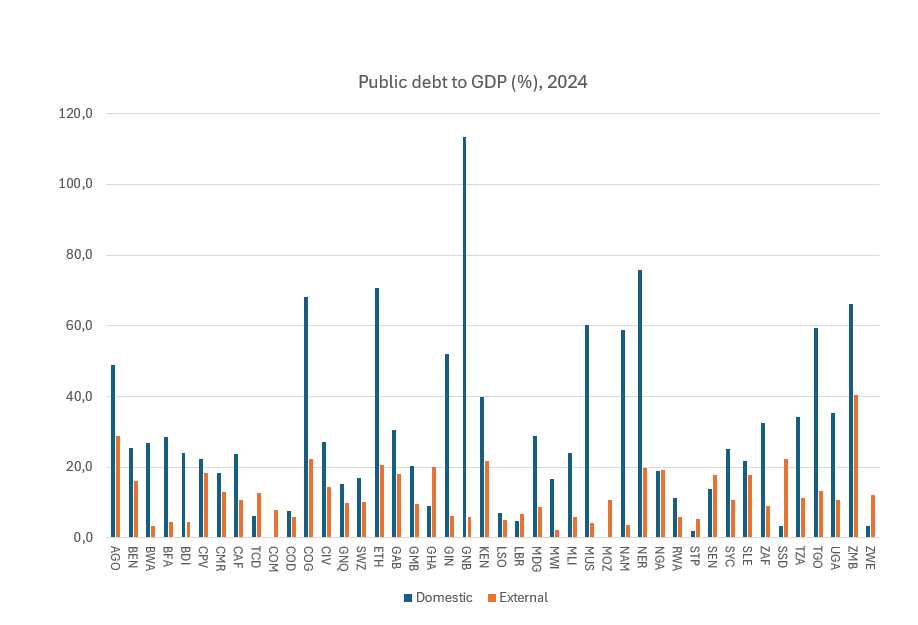
To meet growing development needs and offset declining external financing—especially official development assistance—African countries have increasingly turned to domestic borrowing. Key trends illustrate this shift:
- Across Sub-Saharan Africa, domestic debt rose from 6.7% of GDP in 2016 to 14.9% in 2024.
- In several countries, it now represents nearly one-third of GDP.
- In 2024, domestic debt exceeded external debt in almost half of the region’s 44 countries.
While this shift can reduce external dependence and mitigate vulnerability to international shocks—such as fluctuations in aid, financial markets, or exchange rates—it also raises significant fiscal and financial stability concerns. As the IMF recently noted (Global Financial Stability Report, October 2025, Chapter 3), the growth of domestic financing must be accompanied by heightened vigilance.
Macro-Financial Risks of Rising Domestic Debt
Pressure on domestic financial markets
Heavy reliance on domestic borrowing increases the demand for local capital, potentially driving up interest rates and crowding out credit to the private sector.
Higher fiscal costs
Domestic borrowing is typically more expensive than concessional external financing. As a result, interest payments rise, reducing fiscal space for social spending and investments. In many countries, domestic debt service now consumes roughly one-quarter of public revenues, and in more than three-quarters of countries, it exceeds external debt service.
Increased sovereign-bank contagion risk
Growing sovereign-bank nexus heightens systemic risk through:
- Potential losses on government portfolios during fiscal stress.
- Risks associated with implicit government guarantees.
- Simultaneous deterioration of sovereign solvency and bank asset quality during macroeconomic shocks.
Pressure on international reserves
A significant share of public spending, especially investment, depends on imports. Without sufficient external financing, increased domestic borrowing can erode foreign reserves, exacerbating pressures on the exchange rate and inflation.
What can be done to ensure sustainable development financing?
The rapid rise of domestic debt reflects adaptation to declining external financing. Yet it poses important challenges for fiscal sustainability and macroeconomic stability. Preserving these balances while improving the business environment is essential. Several measures can help mitigate the risks associated with rising domestic debt:
Strengthening public financial management
- Reinforce the legal and institutional framework for fiscal management.
- Increase domestic revenue mobilization.
- Improve efficiency and quality of public spending.
- Enhance governance and transparency.
- Adopt prudent fiscal policies to contain deficits.
- Modernize cash-management systems.
- Reduce domestic arrears to limit and NPL price pressures, liquidity problems and non-performing loans (NPLs) in the banking sector.
Enhancing domestic debt governance
- Publish regular, comprehensive reports on public debt.
- Strengthen risk-analysis capacities and debt-issuance strategies.
Diversifying domestic financing and strengthening financial markets
- Improve regulations.
- Broaden the investor base beyond commercial banks.
- Develop secondary bond markets.
- Promote innovative instruments (green bonds, diaspora bonds, etc.).
- Enhance the banking sector, including by addressing “zombie banks” which are sources of macroeconomic fragility.
- Adopt sound monetary policy frameworks and encourage financial savings.
Key Takeaways
In our previous blog, we emphasized that poorly managed debt can hinder growth, whereas well-managed debt can be a powerful lever to finance the future and reduce poverty.
This analysis shows that domestic debt, while reducing external dependence, introduces challenges related to cost, financial stability, and macroeconomic management.
The choice between domestic and external debt is not only a question of interest rates—it also shapes policy decisions and structural reforms necessary to limit negative effects.
A robust fiscal framework, strengthened debt governance, enhanced banking regulations and diversified domestic financing are key pillars of a sustainable strategy.
In our next blog—echoing our 2002 paper—we will revisit the parameters for optimizing the financing mix between domestic and external sources to reduce risks and preserve debt sustainability.
Debt : Public Enemy Number One in Africa!
African debt often raises concern and misunderstanding. Yet it primarily reflects an unavoidable reality: African countries must invest to drive development — infrastructure, education, health, energy, and more.
So, is the situation truly alarming? And more importantly, how can more resources be mobilized to lift people out of poverty sustainably, without falling into a debt spiral?
Excessive debt… or simply misunderstood?
After the major debt relief initiatives of the 2000s (HIPC Initiative), debt levels have risen again — yet remain below pre-relief levels:
- External debt: USD 807bn in 2024 (+50% in 9 years)
- External debt-to-GDP: 31.5% (2016) → 44.2% (2024)
- Public debt-to-GDP: 38% (2016) → 59% (2024)

Source: IMF, WEO
The real challenge lies not in the stock of debt — lower than in many emerging and advanced economies — but in the cost of servicing it, driven by:
- Lower official development assistance
- Greater reliance on expensive domestic and private financing
- Rising principal repayments on external debt: USD 66bn (2016) → USD 100bn (2024)
- Limited fiscal capacity to absorb the burden

A genuine warning for policymakers
- More than one-third of government revenues are now devoted to debt servicing —
limiting spending on essential services such as education, healthcare, electricity, and roads. - In Sub-Saharan Africa, about 20 countries are already in debt distress or at high risk
(IMF & World Bank assessments).
How to finance development without over-indebtedness?
Four key strategic levers to finance sustainable development:
- Sustained and inclusive growth- Macroeconomic stability, structural reforms, strong governance, efficient public investment.
- Stronger domestic revenue mobilization- Modernized and reinforced tax systems, digitalization, a broader tax base, and more effective oversight of tax expenditures.
- Transparent and responsible debt management- Better risk monitoring and prioritization of high-return investments.
- Enhanced international support- Stronger restructuring mechanisms, increased concessional financing, mobilization of private capital.
The real battle: reducing poverty
The continent’s future is not threatened by debt itself, but by insufficient investment, still-fragile economic governance, and slow structural reforms to improve living conditions: nearly one in two Africans lives on less than USD 3 per day (World Bank).
Poorly managed debt can weigh on growth; but well-managed debt is a powerful engine for development and poverty reduction (Loko et al., IMF WP/03/61)
